


Many application security programs still create more remediation work than engineering teams can realistically absorb. For over a decade, security teams have relied on scanning tools that generate thousands of alerts, pass them over the fence to engineering, and expect developers to drop their current priorities to fix them. This approach creates bottlenecks, slows down release cycles, and leaves critical vulnerabilities lingering in production environments.
Engineering teams do not need more alerts. They need actionable solutions. This necessity has given rise to a new category of technology: agentic AppSec tools.
Agentic application security represents a fundamental shift in how organizations handle code vulnerabilities. Instead of merely scanning and flagging issues, AI-driven security agents operate directly within the developer workflow to identify, assess, and automatically remediate insecure code. By treating security as an active participant rather than a passive observer, agentic tools are becoming the new building blocks of modern application security.
Why Traditional Application Security Creates Bottlenecks
To understand why agentic tools are necessary, we have to look at why current application security programs fail to scale. Traditional tools were built for a different era of software development. They were designed to audit code, not fix it.
The Developer Burden
Developers are measured on velocity. Their primary objective is to build and ship features that drive business value. When a traditional static application security testing (SAST) tool flags a vulnerability, it creates an immediate roadblock. The developer must stop their work, understand the security context, research a fix, write the patch, and push it through testing.
This context switching destroys productivity. When security becomes a blocker, developers often push back, leading to a strained relationship between engineering and security teams.
Alert Fatigue and Triaging Failures
Security teams face their own set of challenges. Modern applications are complex, pulling in hundreds of open-source dependencies. Scanners inevitably produce high volumes of alerts. Security engineers spend hours manually triaging these alerts, attempting to filter out false positives and prioritize true risks.
By the time a verified vulnerability reaches a developer, days or weeks may have passed. The developer has moved on to a new project, making the remediation process even more expensive and time-consuming. This cycle creates massive security backlogs that expose organizations to unacceptable levels of risk.
 What Are Agentic AppSec Tools?
Agentic AppSec tools address the core problem of traditional security scanning by introducing autonomy into the remediation process. They do not just point out problems. They act on them.
Defining AI Agents in Code Security
An AI agent in the context of application security is an autonomous system capable of understanding code context, identifying vulnerabilities, and generating functional code fixes. Unlike basic automation scripts that follow rigid rules, agentic tools leverage large language models (LLMs) and advanced machine learning to reason about code structure. They understand how a specific piece of software functions, allowing them to propose nuanced, context-aware remediations.
From Identification to Remediation
The defining characteristic of an agentic AppSec tool is its ability to bridge the gap between finding a flaw and fixing it. When an agentic tool detects a vulnerability, it analyzes the root cause and generates a precise code fix.
This fix is not presented as an abstract recommendation in a PDF report. It is delivered directly to the developer where they already work. This can shrink a multi-step remediation workflow into a much faster review process.
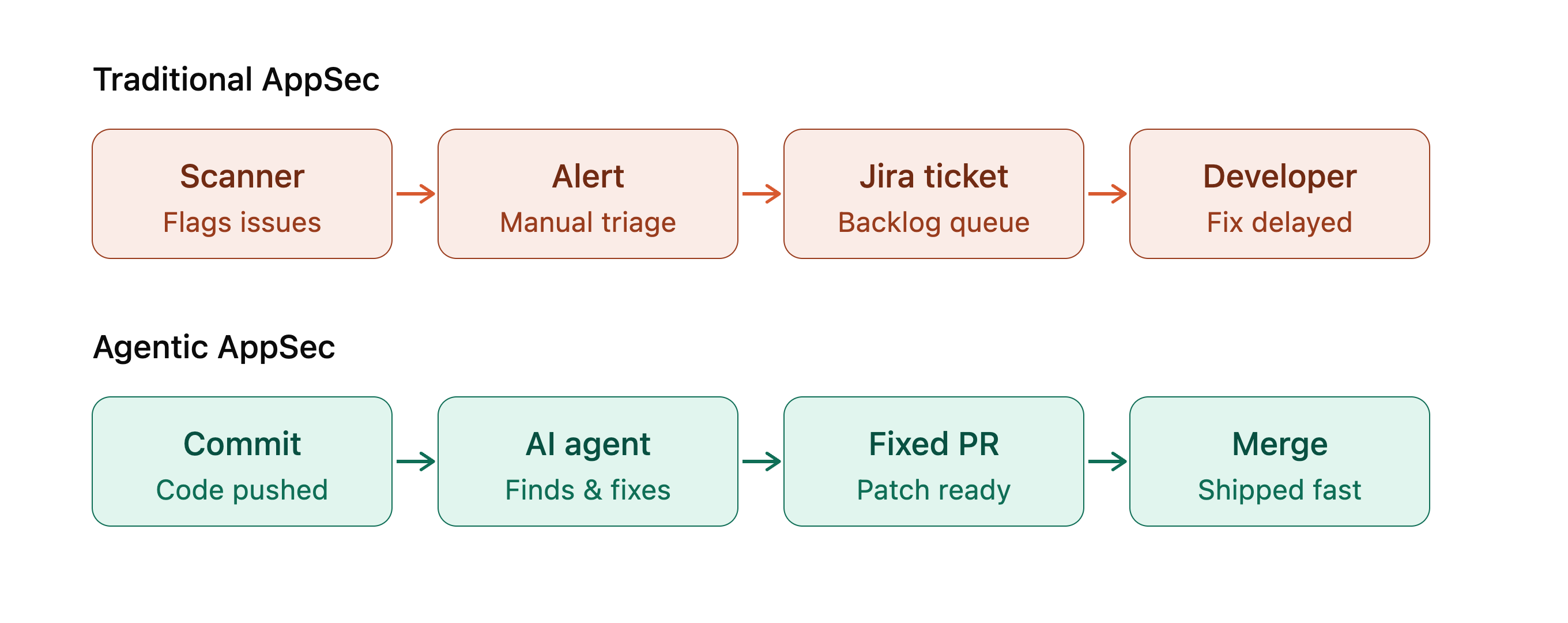
Consider a real-world scenario. Let us say a developer is building a new authentication service and accidentally introduces an unvalidated redirect in a Node.js Express route. A traditional SAST tool would flag this hours later in a CI pipeline, eventually creating a Jira ticket. A week later, the developer has to context switch back to old code to figure out what went wrong.
With an agentic tool, the process is entirely different. The moment the developer opens a pull request, the agent analyzes the commit, recognizes the missing validation, and immediately posts a suggested fix directly in the PR. The developer reviews the generated code, approves it, and merges it before moving on.
The Core Components of an Agentic Security Framework
Building an effective agentic security program requires a platform that can operate quietly within existing engineering pipelines. The best tools share several foundational components.
Context-Aware Scanning
Agentic tools must have a deep understanding of the application architecture. They analyze data flow, control flow, and application logic. This context-aware approach allows the AI agent to distinguish between a theoretical vulnerability and an exploitable flaw, significantly reducing false positives. When the tool generates a fix, it ensures the new code adheres to the project syntax, style guidelines, and performance requirements.
Automated Pull Request Fixes
The delivery mechanism is just as important as the intelligence behind the fix. Agentic tools integrate directly into source control management systems. When a developer commits code containing a security flaw, the agent intercepts the commit, generates the remediation, and immediately opens a pull request with the suggested fix.
This keeps security entirely within the developer workflow. There are no external dashboards to check and no ticketing systems to navigate. The security fix looks exactly like a contribution from another engineer on the team.
Continuous Learning Mechanisms
High performing agentic AppSec platforms learn over time. When a developer modifies a suggested fix before merging it, the system registers that feedback. The AI agent adapts its future recommendations based on how the engineering team interacts with its outputs. This continuous learning loop ensures that the tool becomes more accurate and aligned with the specific coding practices of the organization.
How Agentic AppSec Transforms DevSecOps
The introduction of AI agents into the DevSecOps lifecycle creates practical, measurable improvements in both security posture and developer velocity.
Shifting Left Without Slowing Down
"Shift left" has been a major goal for security teams for years. The idea is to find and fix vulnerabilities as early in the software development lifecycle as possible. However, shifting left with traditional tools often means shifting the burden directly onto the developer.
Agentic tools finally make shifting left practical. By delivering automated fixes directly into the PR process, developers can address security issues before the code ever reaches the main branch. They can secure their projects without delays or extra staff, focusing on innovation rather than manual remediation.
Reducing the Security Backlog
Legacy vulnerabilities are a significant source of technical debt. Many organizations have backlogs consisting of thousands of low and medium severity vulnerabilities that they simply do not have the resources to address. Agentic AppSec tools can be deployed against existing codebases to systematically eliminate this debt. The AI agent can process the backlog, generate fixes, and submit them for review, clearing out years of accumulated risk rapidly.
For example, a team with thousands of legacy cross-site scripting (XSS) warnings in an old monolithic application can set an agentic tool to target specific vulnerability classes. The tool works through the backlog, opening batch PRs for the engineering team to review during scheduled maintenance windows, clearing the queue without requiring engineers to manually write hundreds of individual patches.
Evaluating AI Security Agents for Your Engineering Team
As the market for agentic security tools grows, organizations must know how to evaluate these platforms effectively. Not all AI tools are created equal.
Integration Capabilities
A successful agentic tool must operate invisibly. It should integrate natively with your existing tools. Look for platforms that support your source control providers, CI/CD pipelines, and issue tracking systems. If the tool requires developers to leave their environment or learn a new interface, adoption will likely fail.
Accuracy and False Positive Rates
An AI agent is only useful if developers trust its recommendations. If a tool routinely breaks builds or suggests incorrect fixes, developers will start ignoring the pull requests. Evaluate the tool based on its ability to understand your specific programming languages and frameworks. Run proof of concept trials to measure the accuracy of the generated fixes and track how many suggested PRs are merged without major modifications.
Frequently Asked Questions
What is the difference between SAST and agentic AppSec? Traditional Static Application Security Testing (SAST) tools scan code to identify vulnerabilities and generate alerts. Agentic AppSec tools take the next step by understanding the code context and automatically generating functional code fixes delivered as pull requests.
Will AI agents replace security engineers? No. AI agents automate the tedious, repetitive work of code remediation. This frees up human security engineers to focus on complex threat modeling, architecture reviews, and strategic risk management.
Are automated code fixes safe to deploy? Agentic tools generate code, but human developers always retain control. Every automated fix is delivered as a pull request. The developer must review, test, and approve the code before it is merged, ensuring quality and safety are maintained.
Conclusion
Application security is moving toward more autonomous remediation workflows. More teams are trying to reduce the amount of security work that gets pushed back onto developers manually. Agentic AppSec tools provide a clear path forward, combining the speed of AI with the contextual understanding necessary to generate highly accurate code remediations.
By integrating autonomous agents directly into the engineering workflow, organizations can finally align the goals of development and security. Security becomes a built-in part of the process, allowing engineering teams to ship code with confidence.
Ready to explore the next phase of application security? See how Amplify Security helps teams surface and remediate code vulnerabilities directly inside the pull request workflow. Connect your repositories today and start reducing your security backlog.
Subscribe to Amplify Weekly Blog Roundup
See What Experts Are Saying
BOOK A DEMO






.jpg?width=1200&height=1600&name=IMG-20210714-WA0000%20(1).jpg)
Frequently
Asked Questions
Have a
Questions?
Contact Us
Ready to
Get started?
Book A GUIDED DEMO
