

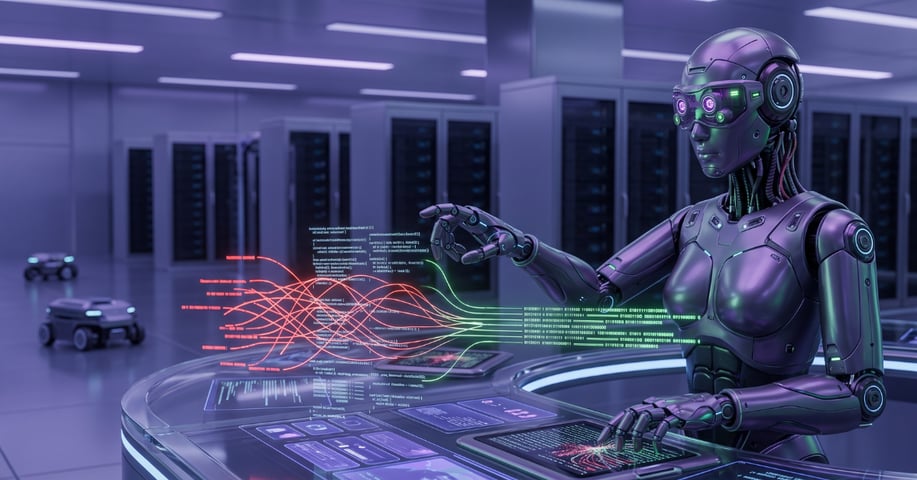
Application security teams are drowning in noise. Developers push code faster than ever using AI assistants, but security tools have not adapted.
Traditional Static Application Security Testing tools scan code without running it. They generate massive backlogs of alerts. Security engineers then waste hours triaging findings that lack real-world context.
Many organizations try to solve this by pointing generic AI models at their security backlogs. They assume an AI that writes code can also secure it. In practice, this approach fails.
Generic AI models do not understand your enterprise risk profile. They cannot prioritize based on true exploitability. They also operate without the governance required for enterprise security.
To bridge this gap, engineering teams are adopting an agentic security harness. This purpose-built infrastructure orchestrates AI agents securely across code review, vulnerability detection, and automated remediation.
Engineering leaders need a system that goes beyond basic text generation. You need orchestration that provides the governance required to scale automated fixes safely.
This piece focuses specifically on the harness architecture itself, the mechanism that turns governance from a policy document into something enforced at the point of action. For the broader case on why enterprise AI code review needs governance in the first place, including the compliance and data-privacy stakes that apply no matter which architecture you choose, see our companion piece on the enterprise governance blind spot.
The Limits of Generic AI in Application Security
An AI model is only as effective as its context. When you use generic AI to write detection rules, you hit three critical roadblocks.
Lack of Environmental Context
A generic AI can spot a vulnerable database query in a vacuum. It cannot tell you if attackers can actually reach that function in production. Without this architectural context, generic AI simply replaces standard false positives with AI-generated false positives.
Missing Workflow Integration
Security is an operational discipline. Discovering a vulnerability is just the first step. You must test the fix, validate it against policy, and merge it through your CI/CD pipeline. CI/CD stands for Continuous Integration and Continuous Deployment, the automated delivery process for code. Generic agents cannot orchestrate this workflow automatically.
Absence of Governance
Enterprise security requires strict auditability. If an AI modifies your code, you need a clear record. You must know why it made the change and who approved it. Simple AI chatbots lack the infrastructure to maintain these compliance-ready audit trails.
What Is an Agentic Security Harness?
An agentic security harness is specialized infrastructure that manages, governs, and executes AI agents across the software development lifecycle.
Instead of using AI like a chatbot for isolated questions, the harness coordinates a fleet of specialized workers. It gives them exact context, enforces strict rules, and integrates their output directly into developer workflows.
An agentic security harness delivers several core capabilities:
Policy and Governance Controls: The harness enforces enterprise policies before any AI takes action. It dictates which vulnerabilities require human review and what coding standards the AI must follow.
Audit Trails: You receive complete visibility into the remediation process. The harness logs the original vulnerability, the triggered rule, and the logic behind the proposed fix.
Custom Detection Agents: You can spin up custom agents tailored to your specific environment. If a new zero-day threat emerges, you can deploy a custom agent to hunt for it immediately.
Secure AI Code Review: The harness deploys specialized agents to review pull requests. These agents check code against your custom policies to flag business logic errors early.
Automated Fixes with Validation: The harness generates actual code fixes. It then validates those fixes to ensure they resolve the vulnerability without breaking your application build.
Enterprise Deployment Controls: Security leaders gain a single control plane to view active agents, measure fix rates, and adjust global policies instantly.
The Role of Human Approval Workflows
Automation should augment security engineers, not replace them. A robust harness integrates human approval gates at critical stages of development.
The AI agent discovers the vulnerability and drafts the code fix. However, the harness ensures high-risk modifications require sign-off from a human engineer. This allows your team to scale output while keeping strict quality control over production code.
How Amplify Console Orchestrates Security
Amplify Console acts as an agentic security harness for modern engineering teams. It is orchestration infrastructure that integrates directly into your source control and CI/CD pipelines.
When you connect Amplify to your repositories, the harness maps your codebase relationships. It uses a built-in Reachability Engine to analyze your code. This engine checks if attackers can actually access a vulnerability in a live environment. This filters out non-exploitable risks and dramatically reduces alert fatigue.
Next, Amplify deploys custom detection agents aligned with your risk profile. When these agents find an issue, our automated fix engine generates a tailored remediation. It submits a pull request directly in the developer workflow.
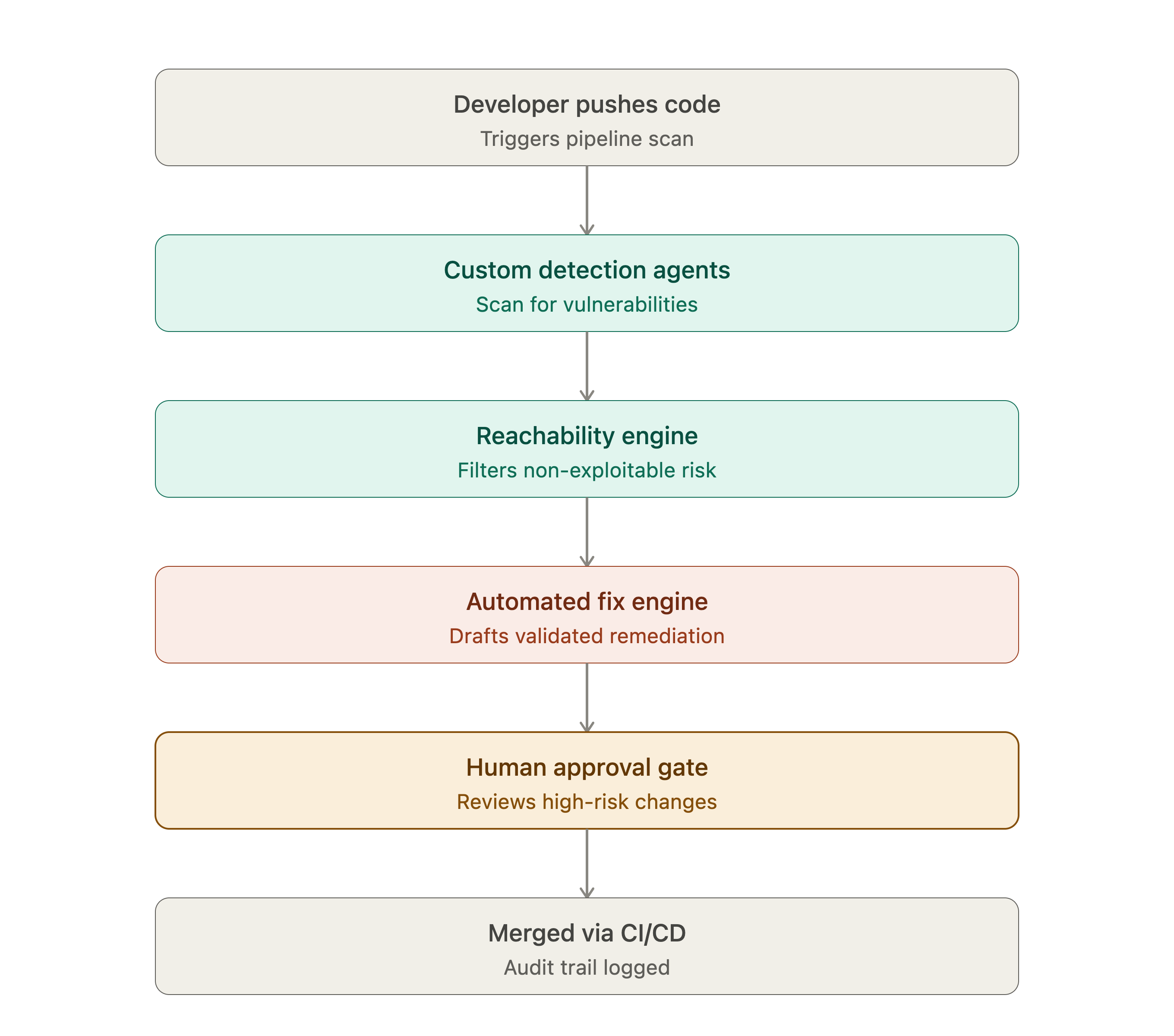
As a security engineer, you act as the pilot. You manage the fleet of agents from a central console, set policies, and review approvals.
For a deeper dive into how this architecture compares to legacy scanners, read our guide on the difference between generic scanners and a security harness. You can also explore our broader approach by comparing traditional AppSec platforms on our platform hub.
How Does a Security Harness Handle False Positives?
A harness utilizes reachability analysis to verify if a vulnerability is actually exploitable in your specific application environment. If an attacker cannot reach the vulnerable function, the harness deprioritizes the alert automatically.
Can an Agentic Security Harness Write Custom Detection Rules?
Yes. You can use the harness to deploy custom detection agents tailored to your proprietary frameworks. This moves your team beyond the limits of generic static analysis rules.
Is It Safe to Let AI Automatically Fix Code?
It is safe when governed by a harness. The harness enforces policy controls, requires human approvals for critical changes, and validates that the fix will not break the build before it reaches a developer.
Does This Replace Existing AppSec Tools?
Not necessarily. A well-designed harness integrates with existing security tools. It takes alerts from various sources, applies advanced triage, and orchestrates the automated fix across your existing toolchain.
Conclusion
Real application security requires context, governance, and operational rigor. Generic language models cannot provide this on their own.
An agentic security harness gives you the infrastructure necessary to make AI truly useful for engineering teams. You can combine custom detection agents, reachability filtering, and automated remediation with strict enterprise controls.
Security engineers no longer need to be the manual bottleneck of the software development lifecycle. With the right harness, you can orchestrate an entire fleet of security agents and turn complex vulnerabilities into validated fixes in minutes.
Tired of manual triage and unvetted AI suggestions? Deploy the security harness built for your codebase and request access to Amplify Console.
Subscribe to Amplify Weekly Blog Roundup
See What Experts Are Saying
BOOK A DEMO




.jpg?width=1200&height=1600&name=IMG-20210714-WA0000%20(1).jpg)
Frequently
Asked Questions
Have a
Questions?
Contact Us
Ready to
Get started?
Book A GUIDED DEMO
