


Security teams are not struggling to find vulnerabilities anymore. The harder problem is fixing them fast enough to keep up with modern development. Scanners can generate endless findings, but developers still have to sort through them, research the right fix, and get changes reviewed before anything improves in production.
Auto remediation changes this dynamic completely. It shifts the focus from finding problems to solving them. Artificial intelligence now allows tools to generate actual code fixes. These systems submit the corrections directly to developers for review, which drastically reduces the time it takes to secure an application.
In this guide, we will explain how auto remediation works. We will look at the technology behind it and explore how it integrates into modern software development.
What Is Auto Remediation?
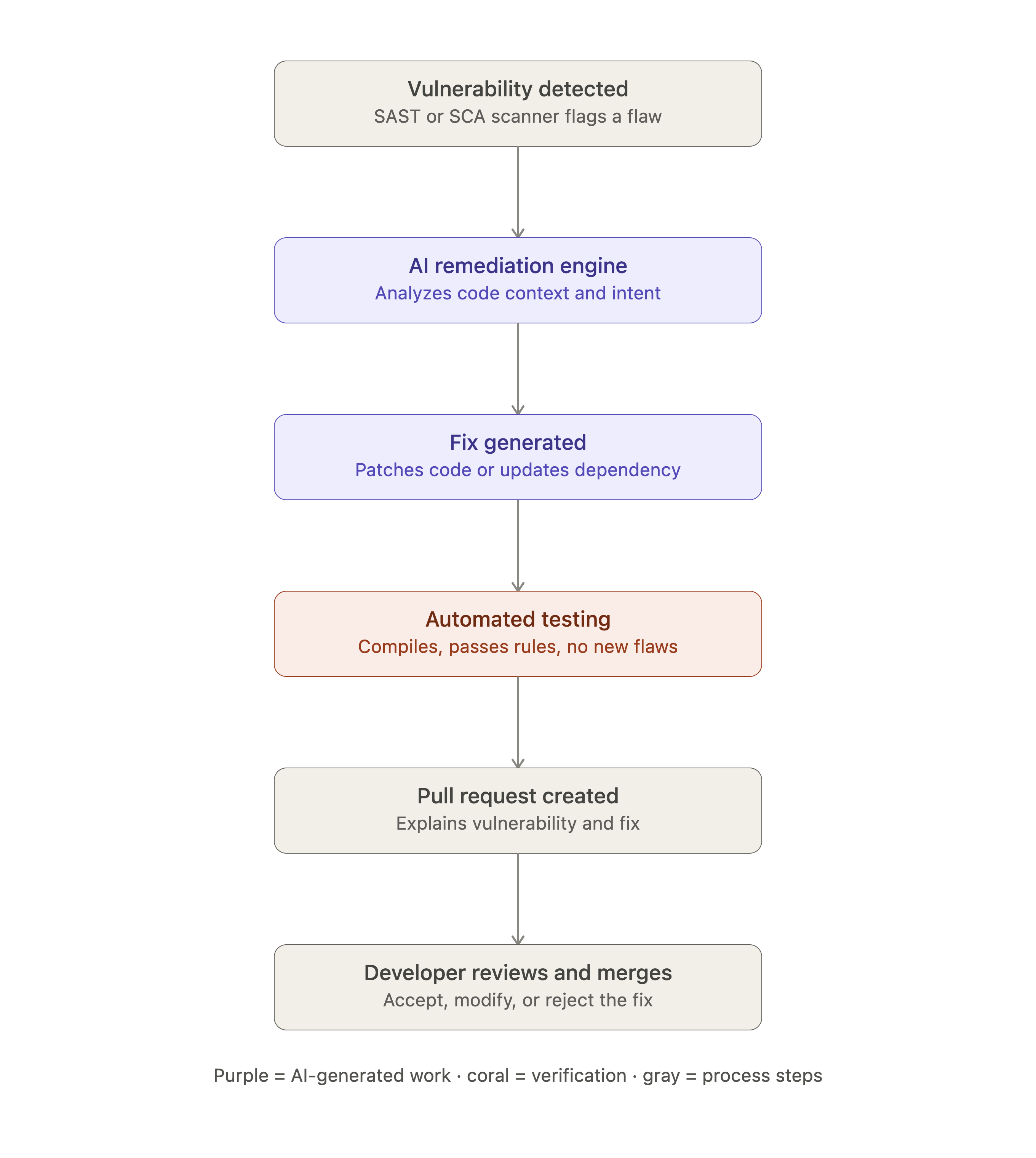
Auto remediation is the process of automatically correcting security flaws in software. It relies on advanced algorithms and artificial intelligence. When a scanner detects a vulnerability, the remediation engine springs into action. It analyzes the context of the vulnerable code and generates a precise patch to resolve the issue.
This process targets two main areas of application security:
SAST: This involves scanning custom source code for flaws without actually running the program. Auto remediation for SAST involves rewriting the developer's original code to remove bugs like injection flaws.
SCA: This involves checking open source libraries and third-party dependencies for known security issues. Auto remediation for SCA typically involves automatically updating the library to a secure version while ensuring the update does not break the application.
How AI Generates Accurate Code Fixes
Traditional security tools rely on deterministic models. These are systems that produce the exact same output given the same input using rigid rules and templates. These models work well for simple configuration changes, but they fail when dealing with complex, custom application code.
Artificial intelligence changes how remediation engines operate. AI models are trained on massive datasets of secure code. They understand the syntax of multiple programming languages and the specific context of a vulnerability.
When a flaw is detected, the AI looks at the surrounding code functions to determine the intent of the original developer. The AI then writes a fix that patches the security hole while preserving the application logic.
The system does not blindly apply patches. It tests the generated code against security rules, ensures the new code compiles correctly, and verifies that no new vulnerabilities are introduced during the fix.
Integrating Fixes with CI/CD and Pull Requests
Auto remediation must fit naturally into a developer's workflow. If security tools force developers to use separate platforms, adoption will fail.
This is why integration with CI/CD is critical. Security checks must happen automatically within the automated pipeline of building, testing, and shipping code.
When an AI engine generates a fix, it does not push the code directly to production because that would be too risky. Instead, it creates a pull request. A pull request is a proposed change to the codebase waiting for a human to approve it.
The pull request contains the suggested fix, a clear explanation of the vulnerability, and a breakdown of how the new code solves the problem. The developer reviews the pull request just like a suggestion from a human peer. They can accept the change, modify it, or reject it. This keeps the human in control while removing the heavy lifting of researching the solution.
Practical Example: Fixing SQL Injection
Let us look at a practical example. Imagine a developer writes a database query that combines user input directly into a SQL string, which creates a critical SQL injection vulnerability.
A traditional scanner will flag the line of code and provide a link to a generic tutorial on SQL injection. The developer must then read the tutorial, figure out how to apply it to their specific framework, and rewrite the code.
An auto remediation engine works differently. It flags the vulnerable line of code and immediately understands that the query needs to be restructured. The AI rewrites the code using parameterized queries. Parameterized queries are a secure way of talking to a database by using placeholders for user input instead of direct strings, which prevents hackers from injecting malicious commands.
The AI packages this new parameterized query into a pull request. The developer reviews the proposed fix, confirms it fits the codebase, and merges it through the normal workflow. That shortens remediation time without removing human review.
The Benefits of Automated Security Fixes
Implementing AI-driven remediation offers several major advantages for engineering and security teams.
Faster Resolution Times: The most obvious benefit is speed. Vulnerabilities are fixed in minutes rather than months, which dramatically reduces the window of opportunity for attackers.
Reduced Developer Friction: Developers want to build features, not become security experts. Providing them with ready-to-merge code fixes removes friction and builds trust between security and engineering teams.
Scalable Security Programs: Human security engineers cannot scale to review every single line of code. Automated remediation allows a small security team to secure a massive codebase. The AI handles the routine fixes, allowing the security team to handle complex architectural reviews.
Lower Security Debt: Most organizations have a massive backlog of known vulnerabilities known as security debt. Auto remediation helps chip away at this debt automatically. It prevents new vulnerabilities from entering the main branch while slowly fixing the old ones.
Overcoming Challenges and Building Trust
Some engineering leaders are skeptical of AI writing code. They worry about the AI breaking the application, which is a valid concern.
Trust is built through transparency and testing. Auto remediation tools must provide clear explanations for every fix and integrate tightly with existing automated testing suites. If an AI-generated fix breaks a unit test, the system should catch it before the developer even sees the pull request.
Organizations should start small. They can enable auto remediation for simple SCA updates first. Once the team trusts the process, they can enable SAST fixes for low-risk vulnerabilities to ensure smooth integration.
Conclusion
The future of application security is not just about finding flaws. It is about fixing them automatically. Auto remediation leverages artificial intelligence to write accurate, context-aware code corrections. By delivering these fixes directly into developer workflows via pull requests, organizations can secure their software without slowing down innovation.
For teams dealing with growing AppSec backlogs, auto remediation can help turn findings into reviewed fixes faster. Amplify Security is built to support that workflow without forcing developers out of their existing process.
Subscribe to Amplify Weekly Blog Roundup
See What Experts Are Saying
BOOK A DEMO






.jpg?width=1200&height=1600&name=IMG-20210714-WA0000%20(1).jpg)
Frequently
Asked Questions
Have a
Questions?
Contact Us
Ready to
Get started?
Book A GUIDED DEMO
