

What Can an AI Security Harness Do? From Detection to Remediation
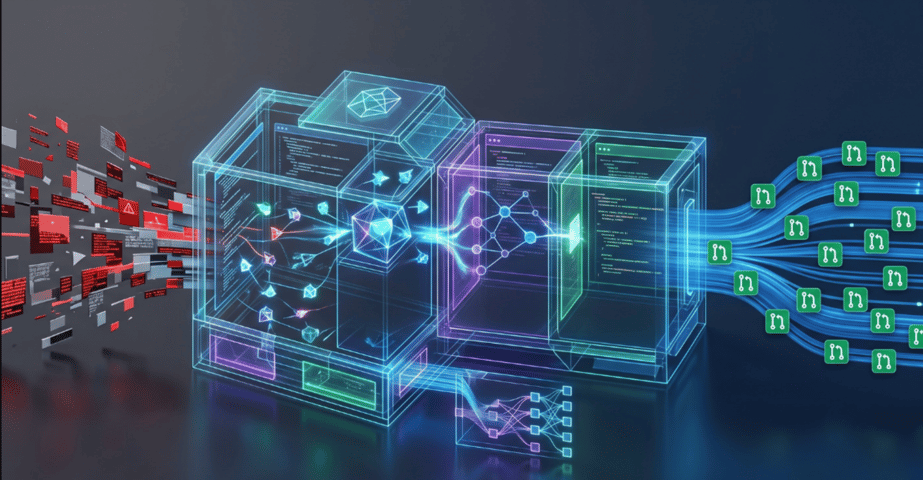
Security engineering teams face a math problem they cannot solve with legacy tools. Developers are writing and deploying code faster than ever before. With the adoption of AI coding assistants, the velocity of software creation has multiplied. Yet, security teams are still using static scanners that generate thousands of low priority alerts. Trying to manually review, triage, and patch every finding is a losing battle.
Related resources:
Explore the agentic AI cybersecurity platform
Compare agentic security harnesses
Many security vendors have attempted to solve this by wrapping a large language model around their existing scanners. They give you a chat box that explains a vulnerability or generates a generic piece of remediation code. That is not enough. Asking a chat interface to write a single rule does not scale. You need infrastructure that orchestrates security tasks autonomously.
This is where an AI security harness comes in.
An AI security harness is purpose built infrastructure that allows security teams to discover, create, deploy, track, and report on custom agentic security detections. It provides the deep plumbing required to turn AI from a passive assistant into an active security workforce. Instead of chasing endless alerts, security engineers can use a harness to move just as fast as their development counterparts.
Below, we detail exactly what an AI security harness can do and how it transforms application security from a bottleneck into an automated pipeline.
The Difference Between a Prompt Wrapper and a Security Harness
To understand the capabilities of a security harness, you first have to understand what it replaces.
A prompt wrapper simply passes your prompt to an underlying AI model. If you paste a snippet of vulnerable code and ask for a fix, it provides an answer based on its training data. It lacks context about your specific codebase, your deployment environment, and your organizational priorities. It cannot deploy a detection rule across hundreds of repositories.
A security harness provides systemic orchestration. It integrates deeply with your code repositories, cloud environments, and existing security tools. It maps the relationships between different services. When you use a harness, you are not just asking a question. You are deploying custom detection agents that understand your specific environment. You are executing cloud to production workflows.
Core Capabilities of an Agentic Security Harness
An effective AI security harness executes across multiple stages of the security lifecycle. It moves beyond static rules and enables continuous, contextual security operations.
Deploying Custom Detection Agents at Scale
Legacy security tools rely on prescriptive rules. The vendor decides what is important, and you are forced to accept their baseline. This creates a massive volume of irrelevant alerts.
A security harness allows you to create custom detection agents in minutes. If your team identifies a specific vulnerability pattern unique to your architecture, you can use the harness to spring up an agent designed specifically to hunt for that pattern. These agents deploy across all your codebases simultaneously. You no longer rely on generic rules that flag safe code. You build detections that matter to your business logic.
Applying Security Native Context
Context is the most critical element in modern vulnerability management. Without context, a critical alert might point to a test environment with no sensitive data. A low priority alert might actually reside in an internet facing application handling financial transactions.
A true security harness maps relationships that generic agents never see. It understands which services talk to each other, how data flows through the application, and where the boundaries of your network reside. By applying this security native context, the harness ensures that your agents are looking for the right things in the right places. It filters out the noise before it ever reaches a human reviewer.
Orchestrating Cloud to Production Execution
Detecting an issue is only the first step. You must be able to act on it. A security harness features the deep cloud plumbing necessary to push custom detections and orchestrated fixes directly into your CI/CD pipelines.
When an agent identifies a flaw, the harness can automatically route the alert, verify the context, and prepare a remediation strategy. This is not a standalone process running on a single engineer's laptop. It is a continuous, automated workflow that operates from the cloud down to the production environment.
Transforming Triage and Reachability
Triage is often the most time consuming aspect of a security engineer's job. Reviewing static findings to determine if they are real, if they are exploitable, and if they matter takes hours. An AI security harness automates this heavy lifting.
Automated Vulnerability Prioritization
A harness ingests alerts from any source, including your existing security stack. It then applies advanced triage automation based on your specific organizational priorities. If your company prioritizes patching vulnerabilities in internet facing APIs over internal admin tools, the harness automatically elevates those specific alerts. It handles the manual sorting, leaving your team with a highly refined list of actionable items.
The Reachability Engine
One of the most powerful features of an advanced security harness is path analysis. Not all vulnerable code is actually executable in a production environment. Sometimes a vulnerable library is imported but the specific function is never called.
The reachability engine within a harness tracks down vulnerabilities that actually matter. It analyzes the execution paths within your application. If a vulnerability is not reachable or exploitable by an attacker, the harness deprioritizes it. This single capability can eliminate massive portions of a security backlog, allowing your team to focus exclusively on real risks.
Moving from Detection to Automated Remediation
Finding a problem does not secure your application. Fixing the problem secures your application. A security harness bridges the gap between detection and remediation through automated code generation and collaborative workflows.
Executing One Click Auto Fixes
When the harness identifies a reachable vulnerability, it does not just send an alert. The auto fix engine generates a tailored remediation. Because the harness understands the context of your codebase, the generated fix aligns with your existing coding standards and architectural patterns.
Security engineers can review the proposed fix and apply it with a single click. The harness then orchestrates the deployment of that fix through your standard version control and pull request processes.
Developer and Security Collaboration
Security should not happen in a silo. A security harness facilitates native collaboration between security engineers and developers. When a remediation is generated, it is presented in the tools developers already use. The security team provides the context and the verified fix, and the development team reviews and merges the pull request. This reduces friction, eliminates lengthy back and forth emails, and drastically reduces the mean time to remediation.
Integrating the Harness into Your Existing Ecosystem
A solution that requires you to rip and replace your entire security stack is rarely successful. A mature AI security harness acts as a force multiplier for your existing investments.
It integrates with your hosted code repositories, your static and dynamic analysis tools, and your ticketing systems. It takes the output from legacy scanners, enriches it with context, filters it through the reachability engine, and orchestrates the response. You do not have to choose between your current tools and AI. You use the harness to elevate your entire environment.
Frequently Asked Questions
What is the difference between an AI security harness and a legacy vulnerability scanner? Legacy scanners use static, prescriptive rules to identify potential flaws, often resulting in high false positive rates. An AI security harness uses custom agentic detections, native context, and reachability analysis to find and fix issues that actually matter to your specific environment.
Does a security harness replace my current security tools? No. A security harness integrates with the tools you already use. It ingests their findings, applies organizational context, and automates the triage and remediation processes, acting as a force multiplier for your existing stack.
How does an AI security harness handle false positives? The harness utilizes path analysis and a reachability engine to determine if a vulnerability can actually be exploited in production. If a vulnerable function is never called, the harness filters it out, drastically reducing false positives.
Can a security harness actually write code to fix vulnerabilities? Yes. The auto fix engine within the harness generates custom remediations tailored to your specific codebase and standards. These fixes can be reviewed and deployed directly into your pipeline via standard pull requests.
Elevate Your Security Engineering
You cannot secure an AI accelerated development pipeline with manual security processes. The volume of code is too high, and the risks are too complex. Relying on chat interfaces to write isolated rules will not scale to meet the demands of a modern enterprise.
You need an infrastructure built for orchestration. You need the ability to deploy custom detection agents, analyze reachability in real time, and push automated fixes directly to developers.
Stop chasing endless vulnerabilities that do not matter. Start orchestrating continuous security that is specific to your needs.
Request early access to Amplify Console and deploy the agentic security harness built specifically for security engineering teams.
Ready to upgrade your AppSec operations?
Subscribe to Amplify Weekly Blog Roundup
Subscribe Here!
See What Experts Are Saying
BOOK A DEMO


Jeremiah Grossman
Founder | Investor | Advisor

Saeed Abu-Nimeh
CEO and Founder @ SecLytics
Kathy Wang
CISO | Investor | Advisor
.jpg?width=1200&height=1600&name=IMG-20210714-WA0000%20(1).jpg)
Alex Lanstein
Chief Evangelist @ StrikeReadyFrequently
Asked Questions
What is vulnerability management, and why is it important?
Why is vulnerability management important?
What makes vulnerability management extremely challenging in today’s high-growth environment?
How can Amplify help me with vulnerability management?
What technology does the Amplify platform integrate with?
Have a
Questions?
Contact Us
Ready to
Get started?
Book A GUIDED DEMO
