


PHP2Shell illustrates the difference between discovering a critical vulnerability and resolving it in production. AI-assisted researchers helped establish the severity of two PHP flaws, but maintainers still had to develop fixes and organizations still had to deploy them. AppSec teams need an accountable path from finding to investigation, ownership, remediation, and evidence. Amplify Console supports the application-security portions of that work, not PHP runtime patching.
Related resources:
Explore the agentic AI cybersecurity platform
Compare agentic security harnesses
The October 2026 PHP2Shell disclosure brought an uncomfortable distinction into focus: a credible security finding can be available long before the last affected deployment is fixed. Vulnerability research, coordinated disclosure, production change management, and post-change verification operate on different clocks.
For AppSec leaders, the lesson is not simply that AI makes vulnerability discovery faster. It is that the process after discovery needs to become more specific about who acts, what can be automated, and which evidence permits closure.
What Did PHP2Shell Reveal About AI-Assisted Vulnerability Discovery?
PHP2Shell shows how AI-assisted research can clarify a complex vulnerability without eliminating the work of independent researchers, open-source maintainers, or deployment owners. On October 21, 2026, PHP released fixes for CVE-2026-109618 and CVE-2026-109619, critical flaws that can permit remote code execution under relevant conditions.
The PHP Foundation's account describes signs of the underlying out-of-memory problem dating to 2024. At that time, the team had not established a concrete remote-code-execution route. Subsequent research changed the evidence available to maintainers.
|
Date |
Documented event |
What it illustrates |
|
2024 |
PHP developers examined the underlying memory-management problem |
Identifying suspicious behavior does not always establish exploitability |
|
July 30, 2026 |
Security firm Calif began auditing PHP |
Focused research can revisit unresolved technical concerns |
|
August 11, 2026 |
Calif and OpenAI independently reported the same root cause with serious exploitability evidence |
Independent findings can clarify the severity of a known problem |
|
August–September 2026 |
Wiz and OpenAI contributed additional attack-vector research |
Coordinated disclosure involves more than one research tool or team |
|
October 17, 2026 |
Amazon's MadPot telemetry observed an exploitation attempt |
Threat activity may precede public release of the advisory |
|
October 21, 2026 |
PHP published security releases |
Maintainer-engineered fixes had to reach downstream users |
Sources: PHP Foundation, OpenAI's coordinated disclosure account, Wiz Research, and Amazon Threat Intelligence.
The PHP Foundation also reported having published 15 CVEs since July 1 while reviewing more than 100 reports that were invalid, duplicated, or not reproducible. That is a concrete reminder that more research output increases the importance of determining which findings are credible and actionable; it is not evidence that every organization experiences the same increase in vulnerability volume.
AI-assisted research helped establish the problem. Humans still had to assess it, create and ship compatible fixes, and decide how to respond to changing disclosure conditions.
What Does “Black October 2026” Mean for AppSec Teams?
Black October is an informal term used in commentary about a concentrated period of cybersecurity incidents and disclosures. It is not an official designation for a single coordinated campaign.
Its practical relevance to AppSec is the pressure of simultaneous security demands. A new advisory may concern application code, a third-party package, a language runtime, or a production configuration. Those findings can share a critical severity rating while requiring very different owners and changes.
PHP2Shell is a useful case: the affected component was PHP itself. Teams had to determine which services used affected runtimes, deploy supported vendor updates, and separately evaluate evidence of possible pre-patch exploitation. An application-code fix would not replace the PHP security release.
For affected versions, fleet-wide exposure assessment, threat-hunting considerations, and patch verification, use Amplify's PHP2Shell incident-response guide. This article addresses the handoff from vulnerability discovery to accountable remediation rather than duplicating that technical playbook.
Why Doesn't Faster Vulnerability Discovery Guarantee Faster Remediation?
Discovery establishes that a security problem may exist; remediation requires evidence that the correct owner implemented the correct change in the affected environment. Those are different responsibilities, and an AI-generated finding cannot settle them by itself.
A security engineer evaluating a credible finding must resolve three questions:
- Applicability: Where does the finding matter in our actual applications or infrastructure?
- Ownership: Does resolution require an application change, dependency update, vendor patch, or incident investigation—and which team can perform it?
- Closure: What evidence demonstrates that the required action was deployed and validated?
An application-code vulnerability may be suitable for a reviewed code change. PHP2Shell, by contrast, requires an appropriate PHP vendor patch and infrastructure deployment. Evidence from a static-code analysis tool cannot prove that a web-serving PHP runtime has been updated.
This is where remediation programs become fragmented. Research findings, scanning outputs, source control, deployment systems, and incident tickets do not necessarily share the same owner or definition of “resolved.”
For the general implementation mechanics of code-level fixes, see Amplify's existing AI remediation workflow guide. The question here is more specific: how does a team route an AI-assisted discovery into the correct, evidence-backed engineering process?
The PHP2Shell Ownership Test: Which Team Can Actually Fix the Finding?
The simplest way to prevent an automated workflow from taking the wrong action is to classify the remediation object before choosing an action. The object might be application source code, a dependency, a runtime package, or evidence of a possible intrusion.
|
Finding or responsibility |
Correct owner or tool category |
What counts as meaningful evidence |
|
Vulnerability in application code |
AppSec and application engineering |
Reviewed change, relevant security tests, deployed fix |
|
Vulnerable third-party dependency |
Application owner and dependency-management workflow |
Corrected dependency, compatibility testing, deployment |
|
Vulnerable PHP interpreter, as in PHP2Shell |
Platform/infrastructure engineering and supported vendor packages |
Vendor patch record and verification of the running PHP service |
|
Possible exploitation before patching |
SOC and incident-response team |
Investigative findings, telemetry scope, documented outcome |
|
Cross-team vulnerability status |
Assigned security owner |
Linked evidence, unresolved exceptions, approved closure |
The ownership test prevents two errors. The first is asking a developer to “fix” a runtime flaw by editing unrelated application code. The second is closing a security finding when the patch exists in a repository or package store but has not been verified in production.
Agentic automation becomes useful when it can help with the applicable task without confusing one team's authority or evidence with another's.
Where Can Amplify Console Actually Help?
Amplify Console is designed for application-security engineering: connecting custom detection, context-aware triage, and automated remediation workflows rather than leaving findings as isolated alerts. Its published capabilities also include reachability analysis, developer collaboration, integrations, and operational visibility through the Operations Cockpit.
Consider a team handling code-level findings while platform engineering is responding to PHP2Shell. Amplify does not replace the platform team's runtime patch. It can help the AppSec team continue moving its own actionable findings toward engineering decisions.
Make detections relevant to the application
Console supports custom detection agents and codebase-specific OpenGrep rules. These let a security team investigate patterns tied to its applications instead of treating every vendor-defined rule as equally relevant. The goal is a stronger starting signal, not a promise of perfect detection or zero false positives.
Establish context before handing work to developers
Console's published triage and reachability capabilities can help security engineers investigate application-code findings and identify what warrants action. This differs from network exposure assessment or proving that a particular PHP runtime is exploitable: those require evidence from the corresponding infrastructure systems.
Move appropriate code findings toward remediation and track the work
Amplify describes customizable automated fix workflows and native developer collaboration. Its integrations documentation describes contextual ticket handoffs and CI/CD connections. The Operations Cockpit provides visibility into agent, detection, and remediation activity.
Together, these capabilities create a more specific product story: from a relevant application-code finding, to contextual investigation, to a developer-actionable remediation workflow, with activity visible to the security team. Testing, approvals, and production validation must still follow the supported configuration and an organization's change controls.
An agentic security harness can organize authorized agent actions around that workflow; the existing agentic security harness guide covers the broader category. This article does not redefine that category or imply Amplify governs every autonomous AI agent in an enterprise.
What Does the Fletch Case Study Demonstrate?
Amplify's published Fletch case study offers a concrete application-security example rather than a hypothetical all-purpose automation promise. It describes a lean security team using Console for codebase-specific detection, contextual triage, remediation workflows, and reporting through the Operations Cockpit.
Amplify reports an 85% reduction in remediation time in Fletch's deployment. That figure is a vendor-published customer result, not an independently audited benchmark or a guarantee for a different customer or vulnerability type. The case also describes more efficient handoffs from findings to engineering work.
The significance for this article is the type of work being improved: application-security findings that can be investigated and moved into developer remediation workflows. It does not show Amplify patching PHP2Shell, conducting a SOC forensic investigation, or independently verifying every production infrastructure change.
The Discovery-to-Verified-Remediation Control Model
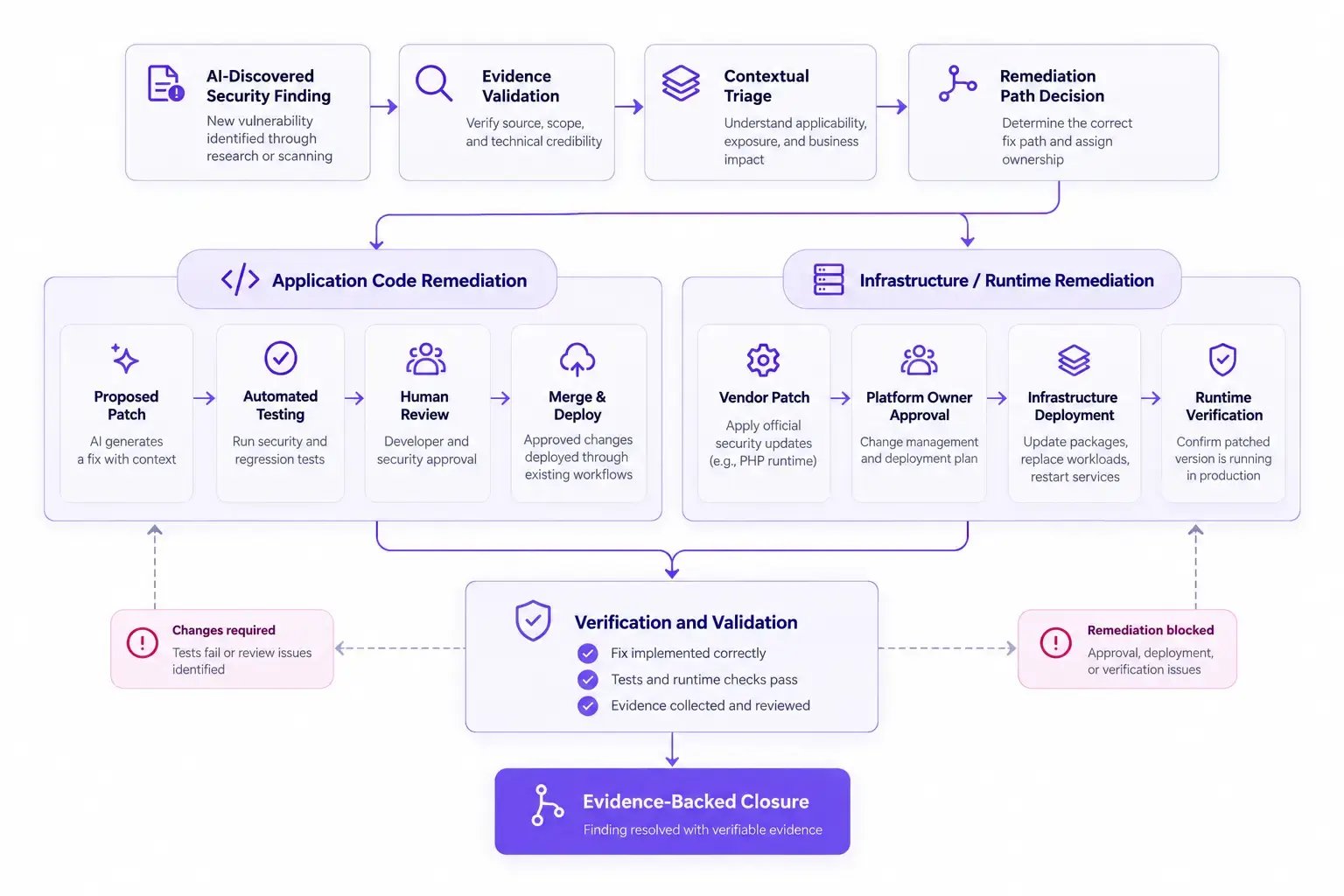
The Discovery-to-Verified-Remediation Control Model asks for a decision and an evidence artifact at each handoff. It separates AI assistance from authorization and prevents a proposed fix, a deployed change, and a verified security outcome from being treated as synonyms.
|
Decision gate |
Useful AI-assisted work |
Accountable decision |
Required evidence |
|
Validate the discovery |
Collect original research and context |
Security owner confirms technical relevance |
Advisory or reproducible finding |
|
Classify the remediation object |
Assemble application context and relevant metadata |
AppSec or platform lead assigns the correct workstream |
Applicability and ownership record |
|
Prepare the change |
Generate a candidate code fix where appropriate |
Developer reviews code; platform owner approves runtime changes |
Proposed diff or vendor package/update plan |
|
Execute the approved change |
Coordinate tasks through supported integrations |
Authorized engineering or infrastructure deployment |
CI/CD or change-management record |
|
Verify the actual outcome |
Collect available test and deployment results |
Responsible owner checks the affected system |
Code-fix validation or running-runtime evidence |
|
Close or escalate |
Summarize status and exceptions |
Security/incident owner accepts or escalates |
Evidence-backed disposition |
Two paths must stay separate. An application-code fix can follow a reviewed patch, testing, approved deployment, and code-level verification. A runtime vulnerability such as PHP2Shell requires the vendor update, platform deployment, active-runtime verification, and any independent compromise investigation warranted by the evidence. Failure to validate either path means the corresponding work remains open.
Figure 1. AI-assisted discovery moves through validation and ownership assignment before branching into application-code and runtime remediation. Neither branch reaches closure without evidence. This is a proposed operating framework, not a representation of a single vendor's end-to-end product capability.
For the deeper technical tests and review requirements of an AI-generated patch, refer to A Generated Security Patch Is Not a Fix Until You Can Prove It. Those details belong to that existing article, rather than being repeated here.
What Should AppSec Leaders Measure After AI-Assisted Discovery?
Counting findings or generated patches does not demonstrate risk reduction. Teams should examine whether work reaches the appropriate owner and produces a verified outcome.
|
Metric |
The decision it helps evaluate |
|
Time from finding to validated assessment |
Is investigation producing actionable evidence? |
|
Time from validation to assigned owner |
Are handoffs delaying the correct fix? |
|
Time to verified remediation |
Does work reach deployment and validation, not just a PR? |
|
Reopened or unresolved findings |
Did validation expose incomplete or ineffective work? |
|
Closure-evidence completeness |
Can reviewers understand why a finding was closed? |
These are recommended operating metrics, not published Amplify performance benchmarks. Compare like-for-like vulnerability categories and risk tiers; code-level fixes and runtime updates follow different timelines.
Frequently Asked Questions
Did AI discover and fix PHP2Shell by itself?
No. AI-assisted research contributed to identifying and demonstrating the vulnerabilities, but independent researchers and PHP maintainers carried out distinct parts of the disclosure and patch-development process. The resulting security releases still had to be distributed and deployed. Describing PHP2Shell as an automatically discovered and remediated vulnerability would erase those responsibilities.
How is this article different from a PHP2Shell incident-response guide?
This article examines how security organizations turn AI-assisted discoveries into accountable remediation work. The incident-response guide addresses the incident itself: affected runtimes, exposure, investigation, patch deployment, and verification. The two articles answer different questions and should retain different primary keyword ownership.
How does Amplify Console help after an application-security finding is discovered?
Amplify describes custom detection agents, context-aware triage, reachability analysis, automated fix workflows, developer collaboration, and Operations Cockpit tracking. Together, those capabilities can help move relevant application-code findings from investigation to actionable engineering work. The exact integrations, review gates, and validation steps should be confirmed for the team's deployment.
Can Amplify Console automatically patch PHP2Shell or close a PHP2Shell incident?
It should not be presented as doing so. PHP2Shell is a vulnerability in the PHP runtime, addressed by supported vendor security updates deployed and verified through infrastructure processes. Potential compromise also requires an appropriate incident-response investigation. Amplify's documented AppSec capabilities complement, rather than replace, those responsibilities.
What evidence should teams require before closing an AI-assisted remediation finding?
Evidence should match the vulnerability and the work performed. For an application-code issue, that can include the original finding, reviewed change, relevant tests, approved deployment, and post-change validation. For a PHP runtime issue, it includes vendor-patch and running-service evidence, while suspected pre-patch compromise must be evaluated separately. A completed agent task or closed ticket is not proof by itself.
The Lesson of PHP2Shell: Match Discovery Speed With Accountable Action
PHP2Shell is an example of meaningful progress in AI-assisted security research—and a reminder that the work after discovery remains highly specific. Maintainers produce patches, platform teams deploy runtime changes, incident responders investigate suspicious activity, and AppSec teams move application-code findings toward engineering fixes.
Amplify Console contributes to that last area through custom detection, contextual investigation, and remediation workflows. Its value should be judged by the evidence it can produce for the actual application-security work in scope, not by claims that one agent or platform can repair every kind of critical vulnerability.
The goal is not simply faster discovery. It is a shorter, clearer, and more verifiable path from a credible finding to the right security action.
Subscribe to Amplify Weekly Blog Roundup
See What Experts Are Saying
BOOK A DEMO






Frequently
Asked Questions
Have a
Questions?
Contact Us
Ready to
Get started?
Book A GUIDED DEMO
