

Best Enterprise AppSec Providers for AI Code Review in CI/CD Pipelines
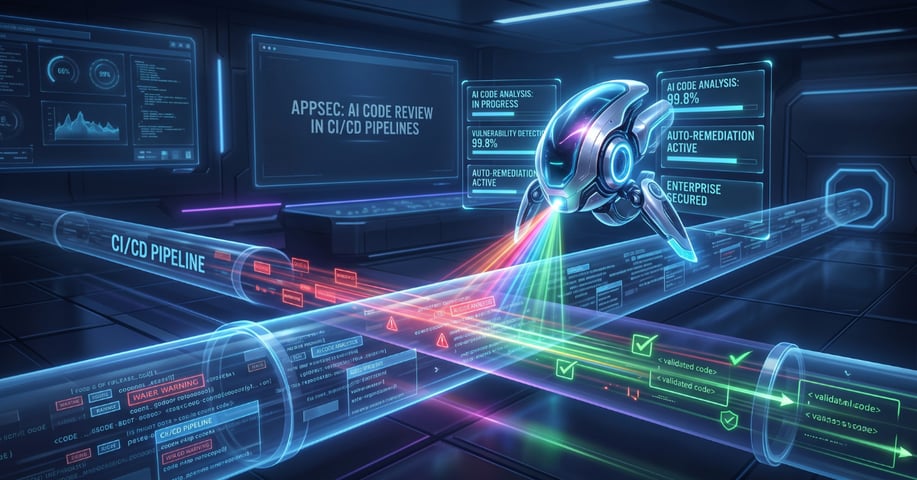
Engineering teams are shipping code faster than ever, often pushing multiple releases a day through their CI/CD pipelines. But traditional manual code reviews and legacy static analysis tools cannot keep up with that pace. When security reviews become the bottleneck, engineering leaders face a bad tradeoff: slow down feature delivery or ship with higher risk.
Finding vulnerabilities is only half the battle. The real challenge is fixing them automatically before they hit production.
Evaluating the best enterprise AppSec providers for AI code review requires looking past the marketing language to understand how these tools actually fit into a developer workflow. This guide breaks down the core capabilities required for enterprise environments and compares the leading solutions available for securing your CI/CD pipelines.
The Shift to AI in Enterprise Application Security
Traditional application security relies heavily on static analysis security testing (SAST). While effective at identifying potential flaws, legacy SAST tools are notorious for generating overwhelming amounts of noise. Security engineers often spend hours triaging thousands of alerts, manually separating false positives from critical vulnerabilities.
Once a legitimate threat is identified, the remediation process introduces further delays. Security teams must document the finding, explain the context, and assign it back to the developer. The developer must context switch, understand the security implications, research a fix, and submit a new pull request.
AI code review changes this workflow by cutting down manual triage and speeding up remediation. By leveraging large language models trained on secure coding patterns and vulnerability databases, modern AppSec tools can understand the specific context of a codebase. Instead of simply flagging a potential SQL injection, an advanced AI security platform analyzes the data flow, confirms the vulnerability, and generates a precise, actionable code patch tailored to the organization's specific framework and language.
Core Capabilities to Look for in AI Code Review Tools
Not all AI security tools are built for the complexities of an enterprise environment. When evaluating providers, security leaders must prioritize platforms that offer the following technical capabilities.
Contextual Vulnerability Remediation
Detection without remediation only creates more work for an already strained security team. The most valuable platforms go beyond highlighting bad code. They generate automated fixes that directly address the vulnerabilities identified by SAST tools. These platforms understand the surrounding business logic and provide actionable patches that developers can review and merge with a single click. For teams looking to streamline this process, adopting automated vulnerability remediation solutions is essential.
Seamless CI/CD Pipeline Integration
Enterprise security tools must meet developers where they work. This means integrating directly into existing workflows across platforms like GitHub, GitLab, or Bitbucket. The AI analysis should trigger automatically during the pull request phase, delivering feedback and proposed fixes as inline comments. If a tool requires developers to log into a separate dashboard to view vulnerabilities, adoption will fail.
High Signal and Low Noise Analysis
Alert fatigue destroys trust between development and security teams. Enterprise AI code review providers must prioritize signal quality over volume. The AI must be capable of contextual analysis, tracing data flows across multiple files to understand if a theoretical vulnerability is actually exploitable in practice. Reducing false positives is critical for maintaining development velocity.
Enterprise-Grade Privacy and Compliance
Proprietary source code is one of an organization's most valuable assets. Submitting codebase snippets to public large language models introduces severe data privacy and compliance risks. Enterprise providers must offer robust data protection guarantees, zero retention policies for analyzed code, and compliance with frameworks like SOC 2 and ISO 27001.
Evaluating the Best Enterprise AppSec Providers for AI Code Review
Choosing the right tool comes down to how well it handles your specific workflow. Here is a breakdown of how the leading providers approach AI-driven CI/CD integration, looking at their core strengths and practical limitations.
Amplify Security
Amplify Security is purpose-built to solve the remediation bottleneck. While many platforms focus entirely on generating more alerts, Amplify integrates directly with your existing SAST tools to automate the fix generation process. When a vulnerability is detected during a pull request, Amplify leverages AI to analyze the context and generate a verified, deployable code patch as an inline comment.
Core Strength: Exceptional at closing the loop between detection and remediation. By generating ready-to-merge code patches directly inside GitHub or GitLab pull requests, it eliminates manual research for developers and instantly reduces vulnerability backlogs.
Practical Limitation: Amplify is laser-focused on automated remediation and workflow integration. Teams looking for a massive, all-in-one dashboard suite for broader IT compliance may need to pair it with their existing visibility tools.
Checkmarx
Checkmarx is a veteran in the application security space and has expanded its platform to include AI capabilities through Checkmarx One Assist. They offer a comprehensive suite that covers SAST, dynamic analysis, and software composition analysis.
Core Strength: Top-down visibility. Checkmarx excels at correlating findings across the entire software supply chain, making it highly effective for large enterprises that require a unified view of their security posture.
Practical Limitation: The platform is heavy. Organizations must be prepared for a more complex deployment and governance setup to fully configure their workflow integrations, which can delay time to value for smaller or faster-moving teams.
Snyk
Snyk built its reputation on a developer-first approach to security, primarily focusing on open source dependencies and container security. Snyk Code represents their foray into AI-driven static analysis, providing real-time scanning and inline guidance.
Core Strength: Outstanding IDE integration. Snyk is excellent at shifting security left directly to the individual developer's local machine before a commit even happens.
Practical Limitation: Relying heavily on Snyk requires a cultural shift. Since much of its power lives in the local IDE, it depends on individual developers actively using it and prioritizing security tasks alongside feature delivery, which can sometimes bypass centralized pipeline enforcement.
GitLab Ultimate
For organizations already heavily invested in the GitLab ecosystem, GitLab Ultimate provides native security capabilities integrated directly into the CI/CD pipeline. It includes automated static analysis, secret detection, and AI features designed to summarize vulnerabilities and suggest potential fixes.
Core Strength: Zero context switching for GitLab shops. Everything from version control to pipeline execution to vulnerability management happens within a single, unified platform.
Practical Limitation: It is highly rigid. Organizations utilizing a best-of-breed toolchain with multiple different version control systems or specialized third-party CI/CD runners will find it difficult to adapt GitLab's native tools to external environments.
Why Automated Remediation Trumps Simple Detection
The fundamental problem in application security is not a lack of visibility. Most enterprise security teams know exactly where their vulnerabilities reside. The problem is execution. There are never enough security engineers to manually guide developers through the remediation process for every single finding.
Automated remediation bridges this gap. When an AI tool provides a ready-to-merge fix, it transforms a complex security task into a simple code review task. The developer no longer needs to become a security expert to fix a cross-site scripting flaw. They simply need to review the logic of the proposed patch and approve it. This drastically reduces the mean time to remediation and prevents vulnerable code from ever reaching the main branch. You can explore how effective this workflow is by testing a one-click remediation tool.
Implementing AI Code Review in Your CI/CD Pipeline
Successfully deploying an AI code review tool requires a strategic approach to avoid disrupting existing workflows.
Define Security Policies: Determine which severity levels require immediate fixes and which can be added to the backlog.
Start with Non-Blocking Checks: Introduce the AI tool in monitoring mode first. Allow developers to see the inline suggestions and automated fixes without blocking their pull requests. This builds trust in the accuracy of the AI.
Integrate with Existing SAST: If you are using a platform like Amplify Security, connect it to your existing static analysis tools to begin automatically generating fixes for your historical backlog.
Enable Blocking for Critical Flaws: Once the team is comfortable with the tool, configure the pipeline to block pull requests that contain critical vulnerabilities until the AI-generated fix is applied.
Gather Developer Feedback: Continuously monitor how developers are interacting with the automated fixes. High rejection rates may indicate a need to adjust the tool's configuration or provide targeted training on specific secure coding practices.
Frequently Asked Questions
How does AI code review differ from standard SAST tools? Standard SAST tools use predefined rules to scan code for known vulnerability patterns, often resulting in high false positive rates. AI code review understands the contextual logic of the code, traces data flows, and can generate specific patches to fix the identified issues.
Is it safe to use AI for enterprise code review? Yes, provided you choose an enterprise-grade provider. Secure providers ensure that your proprietary source code is not used to train public models and adhere strictly to data privacy compliance standards like SOC 2.
Can AI code review replace human security engineers? No. AI is an automation tool designed to handle repetitive triage and basic remediation. This frees up human security engineers to focus on complex threat modeling, architecture reviews, and advanced business logic flaws that AI cannot yet fully comprehend.
How long does it take to implement AI remediation in a CI/CD pipeline? Modern platforms are designed for rapid deployment. Integration with platforms like GitHub or GitLab can typically be completed in a matter of hours, with automated fixes beginning to appear on new pull requests immediately.
Secure Your Code at the Speed of Development
Manual security review bottlenecks can be reduced with the right workflow automation. By integrating AI-powered vulnerability remediation directly into your CI/CD pipeline, you can empower your developers to ship code securely without sacrificing velocity. You can keep release velocity high while reducing security risk.
Stop wasting engineering hours triaging false positives and researching manual fixes. See how Amplify Security automates vulnerability remediation and keeps your development teams moving forward. Request a demo today to see how automated remediation actually works in practice.
Subscribe to Amplify Weekly Blog Roundup
Subscribe Here!
See What Experts Are Saying
BOOK A DEMO


Jeremiah Grossman
Founder | Investor | Advisor

Saeed Abu-Nimeh
CEO and Founder @ SecLytics
Kathy Wang
CISO | Investor | Advisor
.jpg?width=1200&height=1600&name=IMG-20210714-WA0000%20(1).jpg)
Alex Lanstein
Chief Evangelist @ StrikeReadyFrequently
Asked Questions
What is vulnerability management, and why is it important?
Why is vulnerability management important?
What makes vulnerability management extremely challenging in today’s high-growth environment?
How can Amplify help me with vulnerability management?
What technology does the Amplify platform integrate with?
Have a
Questions?
Contact Us
Ready to
Get started?
Book A GUIDED DEMO
