


The interesting question in AI-assisted remediation is no longer whether a model can generate a security fix.
It can produce code. It can modify a vulnerable function. It can open a pull request. In increasingly automated development environments, it may also have access to repository context, test results, issue history, and security findings before it proposes the change.
But none of those capabilities answer the question that ultimately matters:
Should this code be allowed to merge?
That is a different problem.
Generating a patch is a code-generation problem. Authorizing that patch is a security decision.
As more of the remediation workflow becomes automated, AppSec teams will need to become much more explicit about what evidence makes a security change trustworthy enough to enter the codebase.
That does not necessarily mean placing a human reviewer in front of every AI-generated fix.
It means defining what the system must prove before a change is allowed to proceed.
Patch Generation and Patch Authorization Are Different Jobs
Traditional secure code review assumes a relatively familiar workflow.
A vulnerability is discovered. Someone investigates it. A developer changes the code. Tests run. Another engineer reviews the pull request. The change is eventually approved or rejected.
AI compresses several of those steps.
An automated system may be able to move from finding to investigation to proposed remediation in minutes. Over time, some systems may perform substantial portions of that sequence without waiting for a developer to manually initiate each step.
That creates an easy trap: treating successful patch generation as successful remediation.
They are not the same thing.
A patch can look reasonable while addressing only the most visible symptom of a vulnerability. It can modify more code than necessary. It can stop one exploit path while introducing unexpected behavior somewhere else. It can make a failing security test pass without actually removing the underlying weakness.
The real AppSec question therefore changes from:
“Did the AI generate a fix?”
to:
“What evidence justifies allowing this fix into production?”
That second question is where automated remediation becomes a governance problem rather than simply a code-generation feature.
“The Tests Passed” Is Not Enough Evidence
Passing tests is useful evidence, but it is not automatically sufficient evidence. A major reason is that different test types answer fundamentally different questions. Unit tests verify local component behavior, regression suites ensure existing user flows remain unbroken, and security-specific tests evaluate whether a precise vulnerability condition has been eliminated. Passing general continuous integration (CI) simply proves that the codebase still builds and known expectations are met; it does not automatically prove that the security problem itself is resolved.
It is not automatically sufficient evidence.
Existing tests tell you something about the behavior the development team already anticipated. Security fixes often deal with behavior the application was never supposed to permit in the first place.
An AI-generated patch can therefore pass the existing test suite while still leaving meaningful uncertainty.
The change may solve the known input pattern but fail against a variation of the same attack. It may enforce a security condition in one code path while another path remains exposed. It may prevent malicious behavior while unintentionally disrupting a legitimate user flow.
The important distinction is not between tested and untested code.
It is between a change that merely produced a passing build and a change for which the organization has accumulated enough relevant evidence to authorize the merge.
That evidence should reflect the risk of the change.
A one-line input-handling fix in a well-tested component should not necessarily require the same approval process as a change involving authentication, authorization, secrets, data access, or multiple services.
The control should follow the risk.
What Should an AI-Generated Security Fix Prove Before Merge?
A useful review model starts by separating code generation from the evidence surrounding the generated change.
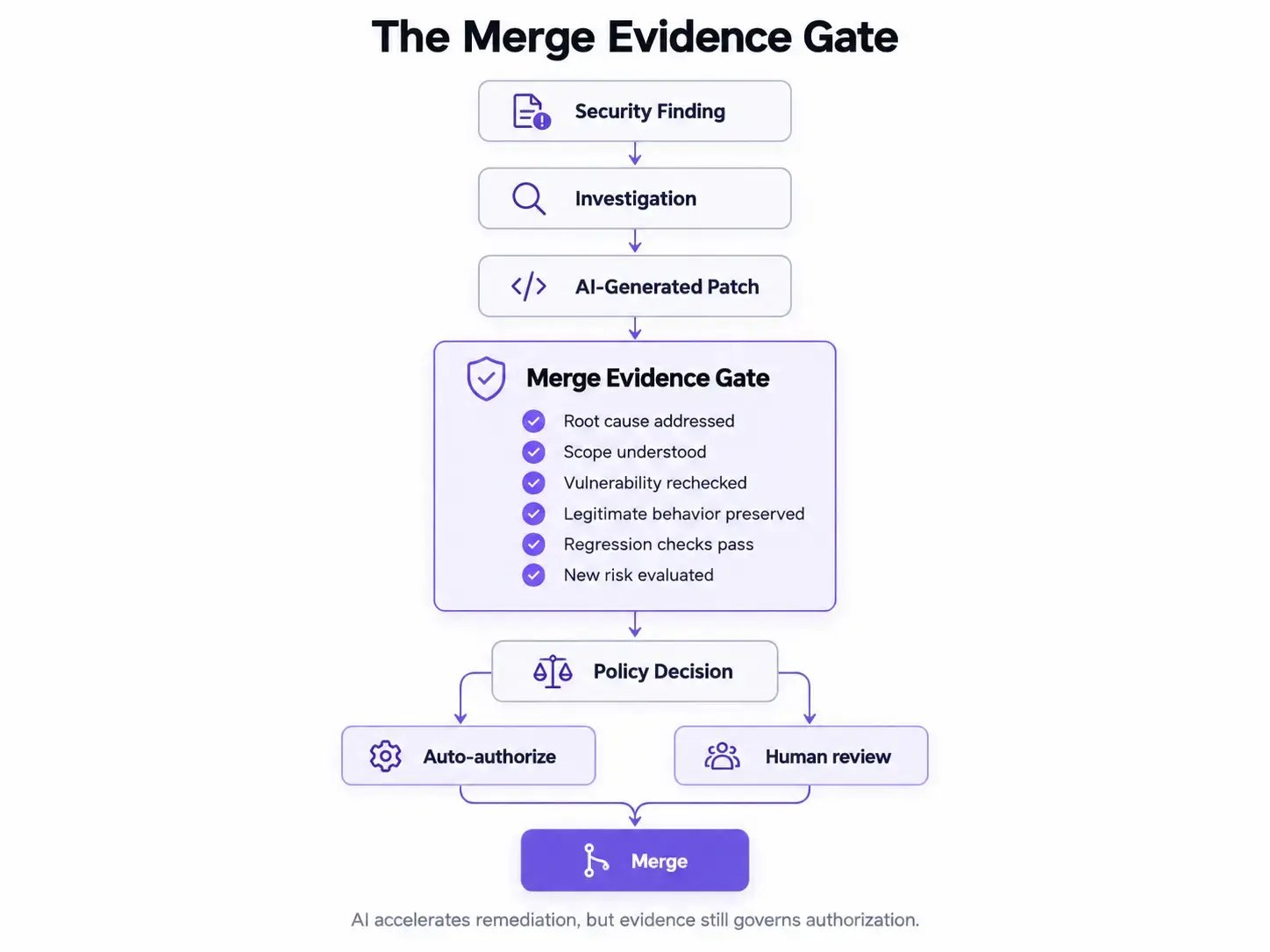
To establish a reliable boundary between code generation and deployment, organizations should introduce a formal Merge Evidence Gate. Under this framework, reviewers or automated policy controls evaluate an AI-generated security patch against six foundational questions:
- Did the change address the root cause? A patch should solve the vulnerable condition rather than simply suppress the specific manifestation that triggered the finding.
- Is the scope of the change explainable? Security reviewers should be able to understand why each meaningful modification was necessary. Unexpected refactoring, dependency changes, configuration changes, or permission changes deserve additional scrutiny.
- Is there evidence that the vulnerable behavior has been removed? A passing general test suite is different from evidence tied directly to the vulnerability that caused the remediation attempt.
- Was legitimate behavior preserved? A patch is not necessarily successful if it “fixes” a vulnerability by breaking the application behavior users actually need.
- Did the change create a new security problem? Remediation can move risk rather than remove it. The new code still needs to be evaluated as new code.
- Was the correct authority allowed to approve it? Some fixes may be appropriate for normal development review. Others may require security approval, elevated branch protections, additional evidence, or explicit policy checks before merge.
Furthermore, these six points should be weighted according to the risk profile of the target component. Low-risk modules or utility functions may weigh passing unit tests and scope bounds higher, whereas sensitive areas like authentication, secret handling, or data access require elevated weighting on security-specific re-checks and explicit authority approvals.
The important idea is that these are not six manual tasks that must always be performed by six people.
They are six things the remediation system should be able to provide evidence for.
Some evidence may come from tests. Some may come from security analysis. Some may come from repository policy. Some may still require human judgment.
The decision architecture matters more than whether every step is manual.
The Reviewer Is Becoming an Evidence Evaluator
AI-assisted development changes the role of the reviewer.
In a conventional workflow, the reviewer often spends much of their time understanding what another engineer changed.
As remediation becomes more automated, the system itself may increasingly provide the first explanation of the vulnerability, the proposed code change, the affected paths, and the test results.
The reviewer’s highest-value contribution can then move away from manually reconstructing the entire change.
Instead, the reviewer evaluates the evidence surrounding it.
- Does the explanation match what changed?
- Does the patch address the vulnerable condition rather than a single example?
- Are the tests relevant to the security claim being made?
- Does the system have enough context to understand the affected application behavior?
- Is the confidence high enough for this class of change?
- Does policy permit this actor to merge this kind of patch?
That is a more useful model of human oversight than simply requiring a person to click Approve on every AI-generated pull request.
Human review is valuable when human judgment is actually required.
A ceremonial approval step is not the same thing as meaningful security control.
Confidence Is Not Authority
A high statistical confidence score from an AI model indicates that the generated code is syntactically coherent and contextually aligned with similar fixes in its training data or repository context. However, model confidence is an internal probability metric, not administrative authority. High confidence does not substitute for policy-based authorization or compliance verification. Governance models must treat model confidence as an input to risk evaluation rather than a self-issuing permission to merge changes into production.
Not Every Security Patch Needs the Same Approval Path
A mature automated remediation workflow should be capable of treating different changes differently.
|
Situation |
Possible review posture |
|
Narrow fix, strong automated coverage, low-risk component |
Automated validation plus standard code review |
|
Authentication or authorization logic |
Elevated review and security-specific evidence |
|
Secret handling or privileged access |
Security approval and stricter policy controls |
|
Cross-service architectural change |
Engineering and security review |
|
Weak test coverage or uncertain behavior |
Manual investigation before merge |
|
Direct merge requested by an automated agent |
Allowed only when predefined evidence and policy requirements are satisfied |
This is where becomes only one part of the larger control model.
The important question is not merely who can press Merge.
It is what conditions must become true before the merge is allowed at all.
That distinction becomes increasingly important as the actor proposing the change may no longer be a human developer.
When pieces of evidence conflict—such as when an AI-generated fix passes unit tests but fails a static analysis check, or passes security checks while triggering unexpected side effects in full integration suites—the remediation pipeline must default to a safe posture. In an evidence-driven model, conflicting or incomplete evidence pauses the automated approval path, requiring explicit human evaluation or targeted escalation rather than allowing the patch to proceed on partial signals.
AI Remediation Creates an Authorization Problem
Imagine an automated system that can:
- identify a vulnerability,
- investigate the affected code,
- generate a patch,
- run tests,
- create a pull request,
- and explain its reasoning.
The more capable that system becomes, the less useful it is to think of it as just another scanner.
It is participating in the software-development process.
And once a security system can take actions rather than simply report findings, AppSec needs controls around those actions.
- What repositories can the system modify?
- What classes of vulnerability is it permitted to remediate?
- Can it introduce dependencies?
- Can it modify infrastructure configuration?
- Can it change authorization logic?
- Can it merge its own changes?
- What evidence must it produce before a human reviewer can approve the patch?
- What evidence would allow policy to approve the patch without manual intervention?
Those are governance questions.
They are also engineering questions.
And they are increasingly inseparable from the technical design of AI-native AppSec.
To operationalize these governance controls, organizations should implement a Graduated Autonomy Framework that clearly scopes AI agent actions across six distinct operational stages:
1. Investigate: Analyze findings, trace call graphs, and determine root causes without modifying code.
2. Recommend: Propose high-level fix strategies or code diffs for human evaluation.
3. Modify: Apply code edits within isolated workspace environments or feature branches.
4. Open PR: Submit pull requests accompanied by detailed context and initial test results.
5. Approve: Evaluate accumulated evidence against policy criteria to grant merge approval.
6. Merge: Commit authorized changes into main production branches.
By separating these stages, security teams can grant autonomous permissions for early steps like investigation or PR creation while reserving higher stages like approval and merge for verified policies or human sign-off.
The Goal Is Not Human Review Everywhere
There is an understandable response to automated remediation:
Require a human to approve everything.
That may be appropriate while organizations are still learning how these systems behave.
It is unlikely to be the final operating model.
If every generated fix still requires the same amount of manual analysis that remediation automation was supposed to reduce, then the organization has automated patch creation without meaningfully automating remediation.
The more useful goal is to determine where human judgment is necessary.
Some changes may eventually have enough deterministic evidence around them that they can move through a governed workflow with very little intervention.
Other changes may remain inappropriate for autonomous approval because their consequences are difficult to reason about automatically.
The distinction should come from policy, risk, evidence, and context rather than from a blanket rule that all AI-generated code is either trustworthy or untrustworthy.
Authorization Does Not End at Merge
Merging an AI-generated patch is not the final step of safe remediation. Continuous post-merge verification, automated canary monitoring, and runtime telemetry to ensure the fix behaves as intended under live traffic. If post-deployment anomalies or unexpected regressions occur, automated rollback mechanisms and feedback loops must trigger, feeding runtime insights back into the remediation model and policy engine to prevent similar failures in future cycles.
A Security Fix Should Arrive With Evidence
The most useful output of an AI remediation system may ultimately not be the code patch itself.
It may be the evidence package surrounding that patch.
The proposed change should arrive with enough context for the organization to understand what vulnerability was addressed, why the proposed code resolves it, what behavior was tested, what changed outside the vulnerable path, what uncertainty remains, and what approval policy applies.
That changes the meaning of automated remediation.
The system is no longer simply saying:
“Here is a patch.”
It is saying:
“Here is the patch, here is why I believe it is safe, here is the evidence supporting that claim, and here are the conditions under which this change is authorized to proceed.”
That is a much stronger foundation for AI-assisted AppSec.
Because as machines become increasingly capable of writing security fixes, the differentiating question will not be who can generate the most patches.
It will be who can determine which patches deserve to become software. As AI capabilities advance, build systems expand, and autonomous agents gain broader development access, the long-term viability of AI-driven remediation depends on building transparent trust. By establishing clear evidence requirements, risk-weighted controls, and explicit authorization boundaries, organizations can turn AI patch generation from an unpredictable experiment into a reliable, trustworthy foundation of modern application security.
Frequently Asked Questions
What should an AI-generated security fix prove before it is allowed to merge?
An AI-generated security fix should provide evidence that it addresses the root cause, keeps the scope of the change explainable, removes the vulnerable behavior, preserves legitimate application behavior, does not introduce new security risk, and is approved by the appropriate authority or policy.
Are passing tests enough to prove an AI-generated security patch is safe?
No. Passing tests are useful evidence, but they do not necessarily prove that the underlying vulnerability was removed. Security-specific validation should confirm that the vulnerable behavior is no longer possible and that legitimate behavior remains intact.
What is a merge evidence gate?
A merge evidence gate is a policy and validation boundary that requires an AI-generated security patch to satisfy predefined evidence requirements before it can proceed to approval or merge.
Does high AI model confidence mean a security fix should be allowed to merge?
No. Model confidence is an input to risk evaluation, not an authorization decision. Permission to merge should come from security policy, evidence, context, and the authority assigned to that class of change.
Should every AI-generated security fix require human approval?
Not necessarily. Low-risk changes with strong deterministic evidence may eventually move through governed automated approval paths, while higher-risk changes involving areas such as authentication, authorization, secrets, or architectural changes may still require explicit human review.
What happens when evidence about an AI-generated patch conflicts?
When evidence is incomplete or conflicting, the automated approval path should pause. The patch should be escalated for targeted human evaluation rather than being allowed to merge on partial signals.
What permissions should an AI remediation system have?
Permissions should be graduated by action. An AI system may be allowed to investigate findings, recommend fixes, modify isolated branches, and open pull requests, while approval and merge permissions remain restricted to explicit policy conditions or human authorization.
Does authorization end once an AI-generated security patch is merged?
No. Safe remediation should include post-merge verification, runtime monitoring, rollback mechanisms, and feedback loops so unexpected regressions or security issues can be detected and addressed after deployment.
AI accelerates everything before the evidence gate. It does not eliminate the gate. See how Amplify approaches AI-native application security

Subscribe to Amplify Weekly Blog Roundup
See What Experts Are Saying
BOOK A DEMO






.jpg?width=1200&height=1600&name=IMG-20210714-WA0000%20(1).jpg)
Frequently
Asked Questions
Have a
Questions?
Contact Us
Ready to
Get started?
Book A GUIDED DEMO
