


Application security teams rarely have a detection problem. Usually, they have a remediation problem. Traditional static analysis tools are highly effective at finding flaws, but they consistently leave teams with backlogs that are impossible to clear manually. Finding a vulnerability is just the beginning. Actually fixing it requires context, prioritization, research, and developer bandwidth.
Generic AI coding assistants try to bridge this gap, but they lack the specific security context required to handle enterprise-scale codebases safely. Agentic AppSec tools take a different approach. By utilizing a purpose-built security harness, modern application security platforms move beyond flagging issues to proposing deployment-ready code fixes that developers can test and validate.
However, not all AI-powered security tools operate the same way, and generating code is easy while generating secure, context-aware code that doesn't break the build is genuinely difficult. Enterprises are right to be skeptical of handing a machine the keys to their production repositories. This guide breaks down the reality of agentic AppSec so security leaders can make informed purchasing decisions.
The Evolution from Scanners to Agentic AppSec
For the last decade, the standard application security playbook has been heavily prescriptive. Vendors provided scanners equipped with rigid rulesets, operating in isolation and generating lists of potential issues without understanding organizational priorities or the specific architecture of the application.
Traditional vulnerability management often creates work instead of reducing it. Every alert requires human triage: a security engineer investigates the finding, determines if it's reachable, verifies if it matters to the business, and opens a ticket. The developer then has to switch contexts, research the vulnerability, figure out how to patch it without breaking existing functionality, and submit a pull request. This workflow takes days or weeks, and the vulnerability remains exposed the whole time.
A concrete example: a developer building a new authentication service accidentally introduces an unvalidated redirect in a Node.js Express route. A traditional SAST tool flags this hours later in a CI pipeline, eventually creating a Jira ticket. A week later, the developer has to context switch back to old code to figure out what went wrong. With an agentic tool, the process looks different: the moment the developer opens a pull request, the agent analyzes the commit, recognizes the missing validation, and immediately posts a suggested fix directly in the PR. The developer reviews the generated code, approves it, and merges it before moving on to the next task.
Defining the Agentic Security Harness
An agentic security harness is purpose-built infrastructure that allows security engineers to deploy custom detection agents at scale. Unlike a generic language model wrapper, a security-native harness has the underlying integrations and workflow depth required to integrate directly into CI/CD pipelines, understanding the relationships within your codebase that generic agents cannot see.
Instead of reporting assumed severity based on a generic CVSS score, an agentic AppSec platform applies organizational context to prioritize issues, then goes a step further by orchestrating proposed remediations.
Why Generic AI Struggles With This Problem
If you paste a vulnerable snippet of code into a standard large language model and ask for a fix, it will usually give you a technically correct answer. It understands the mechanics of a SQL injection and knows the standard library functions required to sanitize input.
But enterprise software isn't a collection of isolated snippets. It's a complex web of microservices, custom internal libraries, and specific deployment configurations. When a generic AI agent attempts to fix a vulnerability without understanding that broader context, a few things tend to go wrong:
- It hallucinates dependencies. The agent might suggest a fix using a standard library, missing that your organization relies on a custom internal utility for data sanitization.
- It breaks business logic. A fix might successfully close a security loophole but inadvertently change how data is formatted downstream, causing silent failures elsewhere.
- It creates a new review burden. If an AI agent opens a pull request with a multi-file refactor that lacks context, human developers spend more time reverse-engineering the logic than they would have spent fixing the bug themselves.
A dedicated agentic AppSec platform needs to solve these exact problems by relying on deep, security-native context, which is the whole reason this category exists rather than everyone just using a generic coding assistant.
What Agentic AppSec Tools Actually Automate
A reliable agentic tool handles the heavy lifting of the vulnerability lifecycle while keeping humans in the loop.
Contextual risk prioritization. Not all critical vulnerabilities require immediate action. A flaw in an internal testing environment poses less risk than a moderate vulnerability in an outward-facing authentication service. Agentic tools automate the triage phase by applying custom organizational logic, evaluating business context, environment, and deployment stage to surface what actually needs attention first.
Reachability analysis. One of the most time-consuming tasks for a security engineer is determining if a vulnerable library is actually executable in production. Agentic tools automate this through a reachability engine that traces the data flow to see if an attacker can actually exploit the flaw. If the vulnerable function is never called, the agent deprioritizes the alert, saving hours of manual investigation.
Drafted code remediation. The defining feature of modern agentic AppSec is the auto-fix engine. When a legitimate vulnerability is identified, the agent generates a highly contextual code patch and pushes the proposed fix directly into the developer workflow, such as a GitHub pull request. The developer reviews the code, runs standard tests, and merges if it passes validation.

Clearing legacy backlog. Agentic tools can also be pointed at existing codebases to systematically eliminate accumulated technical debt. A team with thousands of legacy cross-site scripting warnings in an old monolithic application, for example, can set an agentic tool to target that specific vulnerability class. The tool works through the backlog, opening batch pull requests for the engineering team to review during scheduled maintenance windows, clearing the queue without requiring engineers to manually write hundreds of individual patches.
What AI AppSec Tools Should Not Automate
While AI agents are powerful, they are not a replacement for human oversight. A well-architected security platform uses agents as a force multiplier, not an autonomous replacement for security engineering.
Organizational policy and governance. AI should execute policy, not invent it. The rules that govern what constitutes a critical risk, which repositories require the most stringent checks, and what compliance frameworks must be followed are business decisions. The security harness must let human engineers define the guardrails, and the AI operates strictly within those parameters. (For the deeper operational mechanics of how this actually gets enforced day to day, see our dedicated piece on operational governance.)
Final code approvals. No automated system should push code directly into production without human review. The agent's role is to prepare the fix, test it, and present it in a standard pull request. A human developer or security engineer must always retain the authority to approve, modify, or reject the suggested remediation.
Core Capabilities to Evaluate
When comparing vendors in this space, focus on these architectural requirements.
Deep context integration. Look for platforms that map dependencies deeply across your specific environment. If a vendor relies on a generic language model without the ability to ingest your custom security context, the suggested fixes will be brittle and prone to hallucination.
Continuous learning. High-performing platforms learn over time. When a developer modifies a suggested fix before merging it, the system should register that feedback and adapt future recommendations based on how your team actually interacts with its output, rather than repeating the same near-miss indefinitely.
Pipeline orchestration. An effective agentic tool must integrate smoothly with the security tools you already use, meeting developers where they already work, natively, in GitHub, GitLab, or Bitbucket, rather than requiring a separate dashboard.
Security-native architecture. Ask the vendor directly: is this a general-purpose coding assistant retrofitted for security, or was it built from the ground up as a security-native platform? A true security harness lets engineers create, iterate, test, and deploy custom agentic detections without relying on static reports.
How to Actually Evaluate a Vendor Before You Buy
Test integration capabilities first. A successful agentic tool must operate invisibly. Look for platforms that support your source control providers, CI/CD pipelines, and issue tracking systems. If the tool requires developers to leave their environment or learn a new interface, adoption will likely fail regardless of how good the underlying model is.
Measure accuracy with a real proof of concept. An AI agent is only useful if developers trust its recommendations. If a tool routinely breaks builds or suggests incorrect fixes, developers will start ignoring the pull requests. Run a proof-of-concept trial against your own codebase, not a vendor's demo repository, and track two numbers specifically: how many suggested PRs get merged without major modification, and how many require more rework than the original bug would have taken to fix by hand.
Consider a phased rollout rather than flipping a switch. Even a platform that checks every box above benefits from a staged adoption. Start with routine, well-understood vulnerabilities, dependency updates, basic configuration drift, common static analysis findings. These are repetitive tasks that drain morale but carry low risk when automated. Require manual review for everything in this first phase, and let your developers get comfortable with how the agent interacts with your internal coding standards before expanding scope to more complex logic flaws or less-reviewed repositories.
The Operational Impact
Deploying an agentic AppSec tool shifts how teams spend their time. By automating the initial triage and research phases, organizations can significantly shrink remediation timelines: when a developer receives a pull request with a highly accurate fix already drafted, the friction of secure coding drops. Testing and validation still take time, but the bottleneck of researching the initial fix disappears.
This also changes the relationship between the two teams. Historically, security creates work and development has to do it, which breeds friction. Agentic tools align both sides around a shared platform: security gets the custom detections and compliance reporting it needs, developers get actionable solutions instead of abstract problems.
Frequently Asked Questions
What is the difference between SAST and agentic AppSec? Traditional SAST tools scan code to identify vulnerabilities and generate alerts. Agentic AppSec tools take the next step: understanding code context and automatically generating functional fixes delivered as pull requests.
Will AI agents replace security engineers? No. AI agents automate the tedious, repetitive work of code remediation. This frees human security engineers to focus on complex threat modeling, architecture reviews, and strategic risk management.
Are automated code fixes safe to deploy? Yes, provided the platform is configured with strict guardrails and a human-in-the-loop review process. Every automated fix should be delivered as a pull request, reviewed, tested, and approved by a human before it merges, never auto-merged directly to production.
Do developers actually adopt these tools, or resist them? Developers typically dislike tools that create noisy alerts and false positives, which is the exact failure mode of legacy scanners. In practice, many developers embrace tools that automate repetitive remediation work, provided the platform integrates smoothly into their existing workflow and doesn't break builds.
Moving Beyond Vulnerability Scanning
Vulnerability scanning alone is no longer sufficient. Security teams cannot afford to chase endless alerts that lack context. By implementing an agentic security harness, you can transform your security program from a prescriptive bottleneck into a continuous, context-driven remediation engine, provided you evaluate vendors on the substance above rather than the marketing.
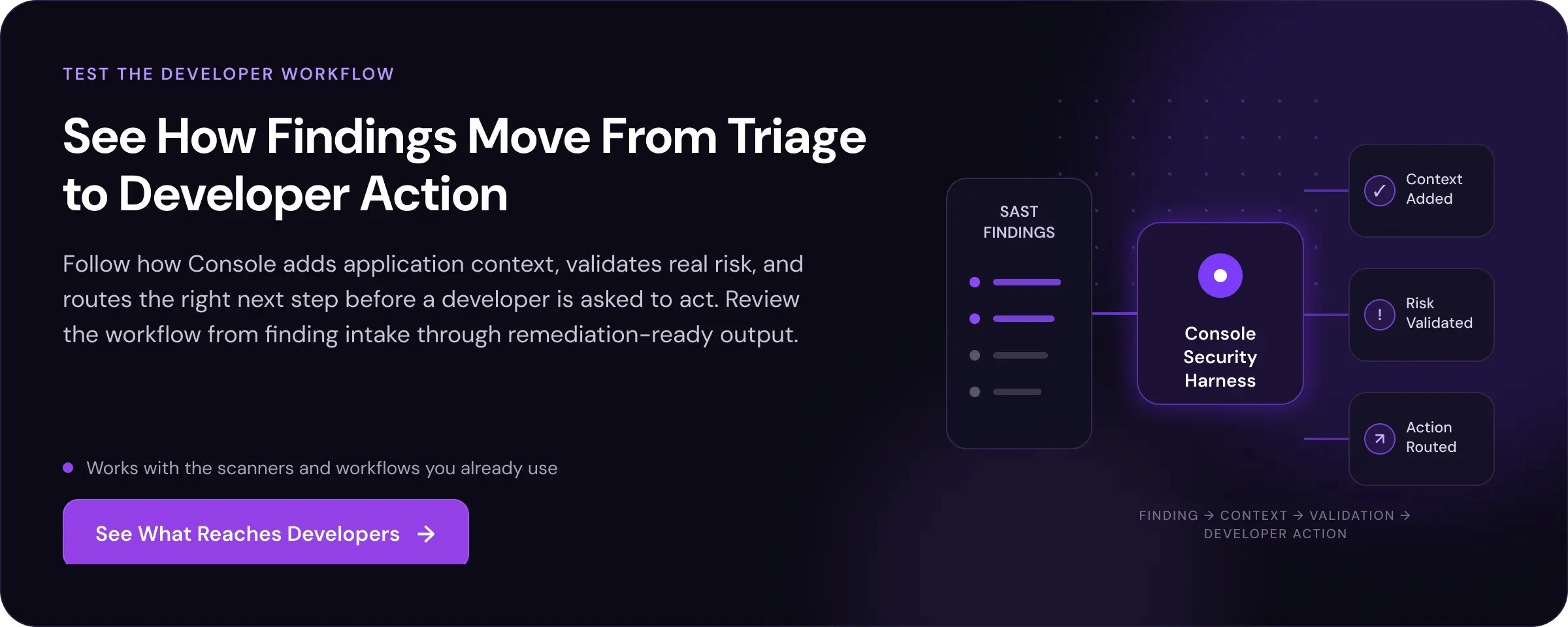
Ready to equip your team with tools that actually draft the fix? Apply for early access to Amplify Console and start building a more context-aware security workflow today.
Subscribe to Amplify Weekly Blog Roundup
See What Experts Are Saying
BOOK A DEMO






.jpg?width=1200&height=1600&name=IMG-20210714-WA0000%20(1).jpg)
Frequently
Asked Questions
Have a
Questions?
Contact Us
Ready to
Get started?
Book A GUIDED DEMO
